
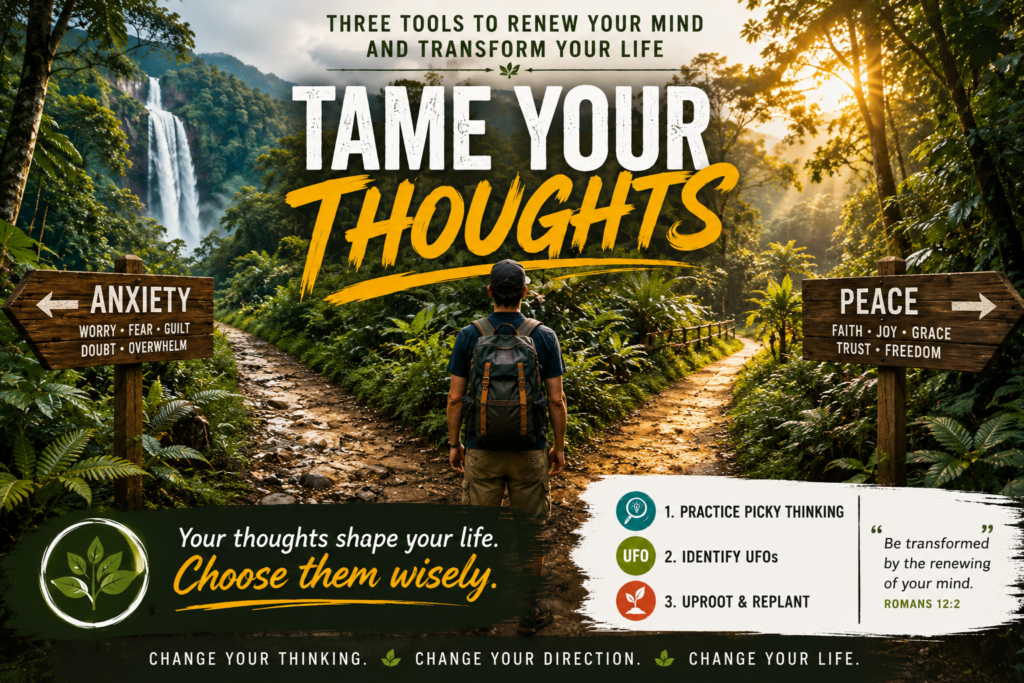
Three Tools to Renew Your Mind and Transform Your Life
One of the reasons I enjoy reading books about personal growth is that many of them eventually arrive at the same conclusion: if we want to change our lives, we have to change our thinking.
Max Lucado’s Tame Your Thoughts approaches this idea from a Christian perspective, combining Scripture, practical exercises, and modern insights about how our brains work. The central message is simple but powerful:
The quality of our lives is heavily influenced by the quality of our thoughts.
As someone who spends time exploring mindfulness, freedom, personal growth, and faith, I found this book to be both practical and encouraging.
The Foundation: Think About What You Think About
The book opens with a challenge most of us rarely consider:
What am I thinking about all day long?
Many of our thoughts run on autopilot. We worry, replay conversations, anticipate problems, and create stories about situations that haven’t even happened.
Lucado introduces the concept of renewing the mind through Romans 12:2:
“Do not be conformed to this world but be transformed by the renewing of your mind.”
The workbook asks readers to identify recurring thoughts and consider how their thinking patterns have been shaped by culture, family, and life experiences.
Reflection Questions
- What recurring thoughts have occupied my mind today?
- Are those thoughts helping or hurting me?
- If my thoughts shape my life, where are they leading me?
My Take
Awareness is the starting point for change. Before I can improve my thoughts, I first have to notice them.
Tool #1: Practice Picky Thinking
Not every thought deserves my attention.
One of the most practical lessons in the book is learning to become selective about what enters my mental “situation room.”
Lucado reminds us that thoughts should be questioned and tested.
The guiding Scripture is:
“Take every thought captive and make it obedient to Christ.” (2 Corinthians 10:5)
Workbook Exercise
Write down a few thoughts currently occupying your mind.
Then ask:
- Is this thought true?
- Is it based on facts or assumptions?
- Does it align with Scripture?
My Take
I’ve spent plenty of time believing fears, assumptions, and worst-case scenarios that never happened. This chapter reminds me that just because a thought appears doesn’t mean it deserves a permanent home.
Tool #2: Identify UFOs
One of the most memorable concepts in the book is identifying what Lucado calls UFOs.
These are unhealthy and false thought patterns that quietly influence our lives.
The workbook asks readers to identify:
- Untruths they believe
- False narratives built around those untruths
- Emotional overreactions caused by those narratives
Reflection Questions
- What negative story do I keep telling myself?
- Where did this story originate?
- Is it actually true?
My Take
Many of our struggles begin with a false belief.
A single untruth can grow into an entire life story if left unchallenged.
Tool #3: Uproot and Replant
Removing negative thoughts isn’t enough.
Something healthy must replace them.
Lucado compares the process to gardening. We uproot unhealthy thinking and intentionally plant truth.
Key Scriptures
“We have the mind of Christ.” (1 Corinthians 2:16)
“You will know the truth, and the truth will set you free.” (John 8:32)
Workbook Exercise
Write down one recurring negative thought.
Now replace it with a Scripture that speaks truth to that issue.
Example:
Negative Thought:
“I’ll never change.”
Replacement:
“I can do all things through Christ who strengthens me.” (Philippians 4:13)
My Take
The goal isn’t emptying the mind.
The goal is filling the mind with truth.
When You Battle Anxiety
Anxiety is one of the most common thought struggles today.
Lucado teaches that anxiety thrives in imagined futures.
Peace is found in the present moment.
Key Scriptures
- Philippians 4:6-7
- Matthew 6:34
- Isaiah 26:3
Workbook Reflection
Rate your anxiety today from 1-10.
What specific thoughts are feeding it?
Which thoughts need to be challenged?
My Take
Most of my anxiety lives in tomorrow.
Most of God’s grace lives in today.
When You Struggle with Guilt
The book draws an important distinction between guilt and shame.
Guilt says:
“I made a mistake.”
Shame says:
“I am the mistake.”
Key Scriptures
- 1 John 1:9
- Romans 8:1
- Psalm 32
Workbook Reflection
What are you carrying that needs confession, forgiveness, and release?
My Take
God forgives more quickly than I forgive myself.
When You Can’t Find Joy
Joy isn’t the absence of hardship.
It’s the presence of hope.
The workbook points to the early church, who maintained joy despite persecution and suffering.
Key Scriptures
- John 15:11
- John 16:33
- Lamentations 3:21-23
Workbook Reflection
What are three blessings in your life right now?
My Take
Joy often begins when gratitude enters the room.
When You Are Lured by Lust
This chapter isn’t just about sexuality.
It’s about unhealthy cravings of all kinds.
Power.
Status.
Recognition.
Possessions.
Key Scriptures
- Job 31:1
- Matthew 5:28
- Philippians 4:8
Workbook Reflection
What am I pursuing that doesn’t truly belong to me?
My Take
What captures my attention eventually shapes my character.
When You Feel Overwhelmed
Every one of us faces giants.
The book uses David and Goliath as a reminder that overwhelming circumstances are not bigger than God.
Key Scriptures
- 1 Samuel 17
- Philippians 4:6-7
- Isaiah 26:3
Workbook Reflection
What Goliath am I facing today?
My Take
The battle belongs to the Lord.
My responsibility is simply to take the next faithful step.
When You Are Puzzled by Pain
This chapter centers on Job.
Pain often leaves us asking why.
God doesn’t always answer the question.
Instead, He offers His presence.
Key Scriptures
- Job 1
- Psalm 34:18
- John 16:33
Workbook Reflection
What has pain taught me that comfort never could?
My Take
Sometimes pain is not punishment.
Sometimes it is preparation.
When You Fear God’s Rejection
Many believers secretly believe they must earn God’s love.
Lucado repeatedly reminds readers that salvation is a gift.
Key Scriptures
- Ephesians 2:8-9
- Romans 8:35-39
- John 10:28
Workbook Reflection
What makes me feel accepted by God?
What makes me fear rejection?
My Take
Nothing can separate me from God’s love.
Nothing.
When You Can’t Get No Satisfaction
The final chapter compares Emperor Nero and the Apostle Paul.
One possessed nearly everything and remained dissatisfied.
The other had very little and remained content.
Key Scriptures
- Philippians 4:11-13
- Psalm 23:1
- Hebrews 13:5
Workbook Reflection
Where am I constantly seeking more?
My Take
Contentment is appreciating enough.
Final Thoughts
My biggest takeaway from Tame Your Thoughts is this:
Freedom begins when I stop believing every thought and start measuring my thoughts against truth.
The book offers practical tools that can be used every day:
- Practice Picky Thinking
- Identify UFOs
- Uproot and Replant
Simple ideas.
Powerful results.
As someone pursuing mindfulness, freedom, personal growth, and faith, I found this book to be a reminder that transformation doesn’t start with changing circumstances.
It starts with changing the way we think.
Question for Readers
What thought pattern has had the biggest impact on your life—for better or worse?