
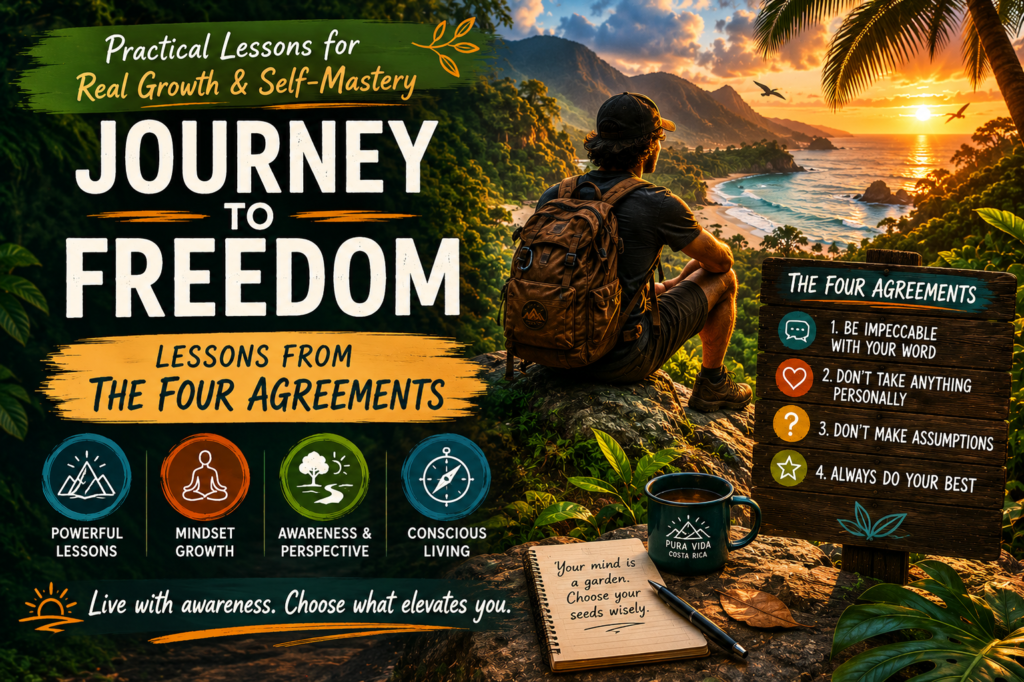
A Reflection on The Four Agreements by Don Miguel Ruiz
Some books give information.
Others quietly change the way you see yourself, relationships, and life.
For me, The Four Agreements falls into the second category.
What makes this book powerful is not complexity. In fact, its ideas are surprisingly simple. But when consistently practiced, those ideas can completely shift the way we react to fear, judgment, conflict, and emotional suffering.
At its core, the book is about freedom.
Freedom from:
- limiting beliefs
- emotional poison
- self-judgment
- fear-based thinking
- unconscious conditioning.
And perhaps most importantly, freedom from becoming trapped in a version of ourselves that no longer feels authentic.
Introduction — The Smoky Mirror
The introduction presents one of the book’s central metaphors:
the Smoky Mirror.
According to Ruiz, human beings once lived connected to truth, love, and awareness. But over time, society created a “dream” built from fear, judgment, conditioning, and false beliefs.
This collective illusion creates what Ruiz calls:
the smoke.
Because of the smoke:
- people struggle to see themselves clearly
- relationships become distorted
- fear replaces authenticity
- judgment replaces love.
The introduction encourages readers to question many of the beliefs they inherited growing up and to begin seeing life more consciously.
One of the strongest ideas in this section is that many of the rules we live by were never consciously chosen.
They were absorbed.
Chapter 1 — Domestication and the Dream of the Planet
This chapter explains how people become conditioned from childhood through:
- reward
- punishment
- approval
- criticism
- social expectations.
Ruiz describes this process as:
domestication.
As children, we learn which behaviors gain love and acceptance and which behaviors create rejection or shame.
Over time, many people stop being authentic and instead become versions of themselves designed to earn approval from others.
This creates:
- fear of judgment
- fear of failure
- perfectionism
- people-pleasing
- emotional suppression.
Ruiz argues that many adults continue unconsciously living according to agreements they made as children:
- “I’m not good enough.”
- “I need approval.”
- “I must be perfect.”
- “My value depends on what others think.”
This chapter invites readers to begin questioning those old agreements and reclaiming a more authentic version of themselves.
Chapter 2 — The First Agreement: Be Impeccable With Your Word
Ruiz describes words as powerful creative tools.
The way we speak:
- shapes relationships
- influences emotions
- affects identity
- reinforces beliefs.
Being impeccable with your word means:
- speaking truthfully
- avoiding gossip
- avoiding emotional poison
- not using words to attack yourself or others.
One of the most important ideas in this chapter is that self-talk matters deeply.
Many people unconsciously repeat harmful internal language:
- “I always fail.”
- “I’m too old.”
- “I’m not talented.”
- “I’ll never change.”
Over time, those words become emotional agreements.
Ruiz encourages readers to become more conscious of:
- language
- inner dialogue
- emotional communication.
Practical Example
Imagine posting creative work online and immediately criticizing yourself before anyone else can.
Instead of:
“This probably isn’t good enough.”
practice:
“I’m learning, improving, and creating honestly.”
That small shift changes the emotional energy behind your actions.
Chapter 3 — The Second Agreement: Don’t Take Anything Personally
This chapter may be the most emotionally freeing part of the book.
Ruiz explains that:
nothing others do is truly because of you.
People react according to:
- their beliefs
- emotional wounds
- fears
- perceptions
- personal experiences.
When someone criticizes, judges, insults, or rejects us, it often reflects their internal reality more than our actual worth.
Taking things personally gives other people control over our emotional state.
The more personally we take criticism, rejection, or opinions, the more emotionally reactive we become.
Practicing this agreement creates:
- emotional stability
- resilience
- inner peace
- confidence.
Practical Example
Imagine sharing a creative project, blog post, or video and receiving a negative comment.
Instead of spiraling emotionally, this agreement reminds you:
- not everyone sees life through the same lens
- criticism often reflects the other person’s mindset
- your worth is not determined by public opinion.
This mindset becomes especially important for creators, artists, writers, and entrepreneurs.
Chapter 4 — The Third Agreement: Don’t Make Assumptions
Ruiz explains that assumptions create:
- misunderstandings
- unnecessary suffering
- conflict
- emotional drama.
Many people expect others to:
- understand unspoken feelings
- read emotional signals
- automatically know their needs.
When those expectations are not met, frustration grows.
The solution is simple but powerful:
communicate clearly.
Ask questions.
Express what you actually mean.
Seek understanding instead of assuming.
This agreement improves:
- relationships
- communication
- emotional clarity.
Practical Example
Instead of assuming:
“They ignored me because they’re upset with me.”
you could simply ask:
“Hey, is everything okay?”
Many conflicts disappear when assumptions are replaced with honest communication.
Chapter 5 — The Fourth Agreement: Always Do Your Best
This chapter shifts away from perfectionism and toward self-awareness.
Ruiz explains that your “best” changes daily.
Your energy, emotional state, health, and circumstances are constantly changing.
Doing your best does NOT mean:
- exhausting yourself
- chasing perfection
- constantly proving your worth.
It means approaching life sincerely and consciously in the present moment.
When people genuinely do their best:
- regret decreases
- self-judgment decreases
- guilt decreases.
This agreement encourages consistency without self-abuse.
Practical Example
Some days your best may look like:
- creating
- exercising
- building momentum
- being highly productive.
Other days your best may simply mean:
- resting
- recovering
- staying emotionally grounded.
Both can still be valid forms of doing your best.
Chapter 6 — The Toltec Path to Freedom
This chapter focuses on breaking old agreements rooted in fear and self-judgment.
Ruiz introduces the concept of:
the Judge.
The Judge represents the internal voice constantly criticizing:
- appearance
- decisions
- creativity
- mistakes
- emotions
- worthiness.
Many people unknowingly live under constant inner criticism.
The path to freedom begins when:
- self-awareness increases
- forgiveness develops
- old emotional agreements are released.
Ruiz emphasizes that healing requires:
- compassion
- patience
- self-acceptance.
Practical Exercise
Spend one full day observing your internal dialogue.
Notice:
- how often you criticize yourself
- how often fear appears
- how often you seek external approval.
Awareness alone can begin interrupting unconscious emotional patterns.
Chapter 7 — The New Dream
This chapter focuses on creating a new personal reality built on:
- awareness
- love
- authenticity
- emotional freedom.
Rather than living from fear, people can begin consciously choosing:
- healthier agreements
- healthier relationships
- healthier perspectives.
Ruiz describes this as:
creating a new dream.
A life no longer controlled by:
- shame
- fear
- emotional conditioning
- unconscious reactions.
This chapter strongly connects to the idea of intentional living and consciously becoming someone new.
Chapter 8 — Prayers and Reflections
The final section includes prayers and meditative reflections centered around:
- gratitude
- surrender
- self-love
- awareness
- forgiveness.
These reflections reinforce the book’s overall message:
that freedom begins internally.
The goal is not perfection.
The goal is awareness, compassion, and conscious growth.
Final Reflection — Why This Book Still Resonates
One reason The Four Agreements continues resonating with so many people is because its message feels timeless.
Most people are not only seeking success.
They are seeking:
- peace
- clarity
- freedom
- authenticity
- emotional balance.
This book reminds us that many of the limitations we carry are not permanent truths.
They are agreements.
And agreements can be changed.
Sometimes growth begins simply by becoming aware of the emotional patterns, beliefs, and fears we’ve been unconsciously repeating for years.
That awareness alone can begin changing the direction of a life.